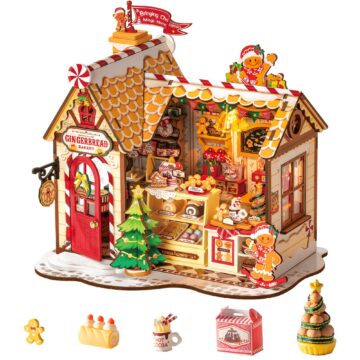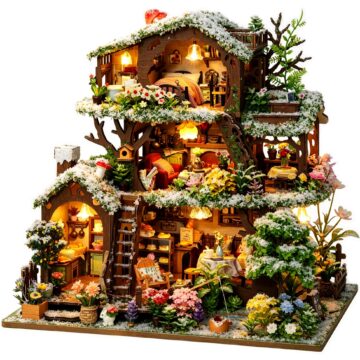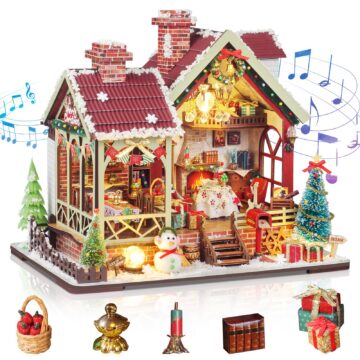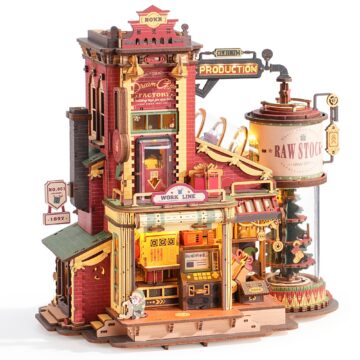
Independent guide: My Cutebee is not the CUTEBEE manufacturer. Product facts come from captured marketplace listings and are checked against the linked product pages; general craft guidance is editorial. As an Amazon Associate, we may earn from qualifying purchases.
A DIY miniature house is wider and more open than a book nook. Instead of looking through one narrow front opening, you normally build one or more rooms with furniture, paper finishes, plants, lighting and an exterior shell. That makes scale, display footprint and interior access especially important buying checks.
The site’s miniature-house catalogue includes CUTEBEE-labelled products alongside Rolife, Flybean, Spilay and other marketplace brands. Brand names should not be treated as interchangeable. Confirm the brand, exact model and ASIN on the live Amazon listing before purchase.
Miniature house formats
| Format | Build experience | Display consideration |
|---|---|---|
| Single room or shop | Contained scene with furniture and décor | Often easier to fit on a shelf; front remains open |
| Greenhouse or garden room | Many plants, clear panels and repeated small details | Clear surfaces show glue haze and collect fingerprints |
| Multi-room house | Longer structural sequence with more subassemblies | Needs a larger base and access from the front or roof |
| Courtyard or architectural scene | Walls, roof lines, landscaping and outdoor details | Irregular outline may need more case clearance |
Start with scale and actual dimensions
Some kits state a conventional scale such as 1:12, 1:18 or 1:24. Others use stylised proportions. A ratio helps with furniture compatibility, but it does not tell you the finished exterior size. Roofs, bases, façades and battery boxes add space.
For example, the catalogue includes Rolife Cathy’s Flower House, described as a 1:18 greenhouse kit, and Rolife Sakura Tree House, described as a 1:12 kit. A 1:12 accessory is roughly twice the linear size of a 1:24 equivalent, so do not mix furniture based only on similar product photos. See the miniature scale guide for calculations.
What to verify about lighting
“With LED” can mean that the kit supplies a complete battery-powered circuit, but it can also omit batteries or require the buyer to assemble lamp shades and route wires. Before ordering, check:
- the number and type of batteries;
- whether the switch and battery holder are included;
- whether glue is required near the wire route;
- whether the battery compartment remains accessible;
- whether the photographed lights are part of the exact model revision.
Test the supplied circuit before installing walls or ceilings. Do not substitute a voltage or remove a resistor unless the manufacturer documents that change. The LED guide covers safe planning and troubleshooting.
Representative house styles in the catalogue
Greenhouses and botanical rooms
Rolife Cathy’s Greenhouse and RHZN Botanical House focus on plants and transparent surfaces. They reward careful tweezers work, but the repeated leaves and containers can take longer than the structural shell suggests.
Cafés, kitchens and shops
Rowood No.17 Cafe, Rolife Baking Kitchen and Casrra Pet Shop use recognisable room layouts. These can be approachable when sheets are clearly labelled, but food, packaging and shelving add many small decorative steps.
Cabins and courtyards
Rolife A-Frame Cabin, Spilay Yaquan Courtyard and Isseve Bamboo Spring Courtyard make more architectural display pieces. Check exterior dimensions, roof access and whether the base fits the intended case.
How to estimate difficulty
Piece count alone is unreliable across miniature houses. Ten pre-cut walls may assemble faster than ten paper flowers. Look for the work types involved:
- pre-coloured parts versus painting and wallpaper;
- large structural panels versus repeated tiny props;
- straight walls versus curved or angled façades;
- pre-wired lighting versus individual lamp assembly;
- clear, model-specific instructions versus generic diagrams.
A first house is easier to manage when parts are labelled, the interior remains accessible and the lighting can be tested before the last wall closes.
Included does not always mean ready to build
A listing may call a product a “complete kit” while excluding glue, paint, batteries or cutting tools. Shipping rules can change what a seller includes. Compare the written box contents and required-supplies section. Do not assume that tweezers, figures or a dust cover shown in staged photography are supplied.
Display and maintenance planning
Measure the model’s finished width, height and depth, then add clearance for a cover, removable roof, switch and power lead. Direct sun can fade paper and paint; heat can affect adhesives and batteries. Open-front houses collect dust faster than enclosed nooks, especially around plants and fabric.
Handle the finished model from its structural base, not a roof sign or balcony. If a display cover is important, compare the internal dimensions in the display cases and stands collection before purchasing the kit.
Miniature house buying checklist
- Exact brand, model and ASIN
- Finished exterior dimensions
- Stated scale and accessory measurements
- Pre-coloured, paint-required or mixed finish
- LED type, power source and battery access
- Glue, paint, tools and batteries included or excluded
- Instruction language and format
- Age and safety guidance
- Current seller, delivery and return terms
Browse the full DIY miniature house collection, compare it with the miniature house selection guide, and plan adhesives with the material-by-material glue guide.
Browse our hand-picked miniature houses
Every kit is shortlisted for build quality and shelf appeal. You check out on Amazon, where the current seller, delivery estimate and return terms are shown before you buy.