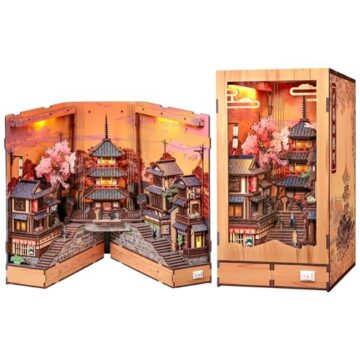
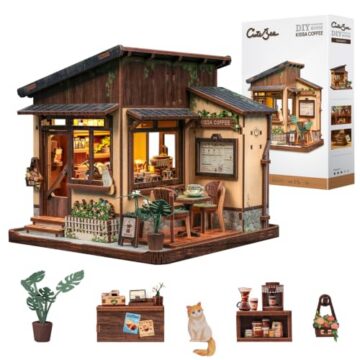
A finished miniature deserves more than the nearest empty shelf. The display must fit the model, allow access to its switch or battery compartment, protect fragile details and avoid conditions that fade paper, soften glue or corrode metal. The best solution can be an ordinary bookshelf, a clear cover or a dedicated case; the right choice depends on the model and the room.
Measure before choosing a shelf or case
Record the model’s maximum width, height and depth after assembly—not just the package dimensions. Include protruding roofs, signs, handles, feet and cables. Then add working clearance:
- Space to lift or slide the model into position without scraping it
- Access to switches, plugs and battery doors
- Room for a removable roof, front panel or dust cover
- Clearance around vents or powered components
- Enough depth that the shelf edge cannot catch fragile front details
For a book nook, also measure the gap between the books that will flank it. Avoid compressing the side walls with heavy hardbacks. Use stable bookends if the books do not stand independently.
Open shelf vs display case
| Option | Advantages | Trade-offs |
|---|---|---|
| Open shelf | Easy access, low cost, no reflections | More dust, handling and accidental contact |
| Clear acrylic cover | Good dust protection, light visual weight | Needs exact sizing; scratches if cleaned badly |
| Glass cabinet | Strong protection and multi-model capacity | Heavy, reflective and furniture-sized |
| Wall-mounted case | Uses vertical space and can create a gallery | Requires secure installation and load planning |
| Individual base and cover | Easy to move as one unit | Base increases total height and width |
Browse the display cases and stands collection to compare formats. Confirm internal dimensions and material specifications on the seller’s current listing before buying.
Choose a stable location
Use a level, rigid shelf rated for the combined weight of models, cases and books. Keep miniatures away from shelf edges, door swings, speakers, unstable furniture and areas where bags or sleeves can catch them. In homes with children or pets, enclosed displays and wall anchoring may be more appropriate.
A non-slip museum-style putty can help secure some bases, but it may stain porous or painted surfaces. Test compatibility and follow the product instructions. Never rely on putty to compensate for an unstable shelf.
Control sunlight and heat
Direct sunlight can fade printed paper, fabrics and paint. Heat can soften some adhesives, warp plastic and shorten battery life. Keep displays away from sunny windows, radiators, fireplaces and hot electronics. If the room receives strong daylight, use blinds or UV-control measures suitable for the window and valuable object.
LEDs inside a kit generally produce less heat than incandescent bulbs, but power systems still need to be used as designed. Do not enclose a powered model in a way that contradicts its instructions.
Manage humidity
Wood, card and paper respond to moisture. Very damp air encourages warping and mould; extremely dry conditions can make some organic materials brittle. Aim for a stable indoor environment rather than rapid swings. Avoid bathrooms, unconditioned basements and shelves directly beside humidifiers.
Silica gel can help in a closed case if used correctly, but it requires monitoring and replacement. Keep loose packets out of reach of children and pets.
Lighting the display
A book nook’s built-in LEDs often provide the main effect. For cabinets or unlit models, use low-heat lighting with tidy cable management. Position external lights to reveal depth without shining directly into the viewer’s eyes or creating strong reflections on a cover.
Test colour temperature before permanent installation. Warm light supports cafés, libraries and period rooms; neutral or cooler light can suit workshops, vehicles and modern scenes. Our LED lighting guide explains internal systems and troubleshooting.
Battery and cable access
Do not build a display that requires dismantling the model every time batteries need replacing. Leave finger clearance around switches and battery covers. If a model will remain unused for a long period, follow the manufacturer’s storage advice; removing batteries can reduce leakage risk in many devices. Never mix battery types or bypass the specified power arrangement.
Dusting without damage
- Turn off and disconnect the model.
- Move it to a clear, padded work area if it can be lifted safely.
- Use a clean, soft brush to move dust toward a low-suction source rather than blasting air into the scene.
- Support loose furniture and paper parts while cleaning nearby.
- Clean acrylic with a product and cloth intended for acrylic; household glass cleaners can damage some plastics.
- Return the model only after every surface is dry.
Compressed air can dislodge tiny parts, force dust deeper into corners or spray propellant. Use it only if the model and product instructions make it safe.
How to arrange a collection
Group by visual story
Place related themes together: streets and shops, botanical rooms, transport models or fantasy scenes. Repeated colours make varied brands feel intentional.
Vary height
Use stable risers inside a deep cabinet so back-row pieces remain visible. The riser must support the object fully and resist slipping.
Create breathing room
Dense shelves hide detail and make cleaning risky. A small gap around each model helps the silhouette read and gives your hands a safer route.
Rotate seasonal pieces
Storing part of a collection reduces crowding. Photograph the model, label removable pieces and use acid-free tissue or suitable archival materials for delicate surfaces.
Book nook placement ideas
- Between similar-height books: creates the classic hidden-world effect.
- At eye level: shows interior depth and reduces the temptation to pick it up.
- At the end of a run: easier switch access, supported by a bookend.
- In a clear individual cover: useful for open shelving in dusty rooms.
- As a themed reading corner: pair the scene with related book covers without blocking airflow or access.
Metal model display considerations
Etched metal models can have sharp points and relatively high weight in a small footprint. Use a stable base, avoid damp locations and minimise direct handling. Some metals and finishes react to cleaning chemicals, so follow the manufacturer’s care instructions. Browse metal model kits and check finished dimensions before choosing a shared case.
Final display checklist
- Internal case or shelf dimensions verified
- Stable surface and appropriate load capacity
- No direct sun, excessive heat or moisture
- Safe access to switch, cable and batteries
- Fragile front details protected from books and sleeves
- Cleaning route and maintenance schedule planned
- Children, pets and earthquake or tip-over risks considered
Browse our hand-picked kits
Every kit is shortlisted for build quality and shelf appeal. You check out on Amazon, where the current seller, delivery estimate and return terms are shown before you buy.